What's new
Ram Heavy Duty Forum

Register a free account today to become a member! Once signed in, you'll be able to participate on this site by adding your own topics and posts, as well as connect with other members through your own private inbox!

Fifth wheel/Gooseneck 5500 discussions!

Pressure_welder

Well-Known Member
Messages
269
Reaction score
275
Points
63
SO! i am going to post a controversial topic here for discussion for those interested. So for quick backstory i have a welding business shop/mobile, and we upgraded our welding rig in november when i took delivery of our 2022 ram 5500 laramie 60" C/A. I got tired of worrying about payload numbers when we hooked upto a trailer with our 3500 drws, plain and simple we were just over payload capacity when hooked upto our fifth wheel, with a fully outfitted welding bed. To be legal i had to remove the welder/bottles and some tools. Now i just frankly dont care what i hook upto i will always be legal, with a fully outfitted bed i still have almost 6000LBS payload left, and about 2800lbs left over when hooked upto our fifth wheel/boat combo which is a nice buffer which i always like to have. Right now on our current welding bed i am running with the gooseneck ball about 12" behind the axle, i run a reese goosebox. Its of course not IDEAL but the towing characteristics of the truck are entirely un-changed with 12" behind the axle. I do like having all of my tools/welder/bottles on the truck when heading to the lake its sure nice to have that swiss army knife with me for any break downs or possible repairs we may encounter, even having 15,000 watts of generator power in case of a power outage is nice, welder sure isnt as quiet as a honda generator though lol

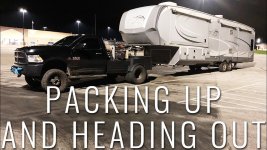
Onto the question at hand, i am SICK of steel work beds even with quality coatings. So ive started fabbing a new aluminum canadian style welding bed, saddle cabinet at the front, and my sloop behind that. Will have the tapered section at the back for work table etc. Ive seen it done many times, and even witnessed it on the road with some pipeline 3500 drw rigs where they've put their turnover ball what seems like 3 or 4" from the end of the frame, pulling 35+ft fifth wheels, granted the ass end is certainly squated they claim to encounter zero issues. There has to be less weight on the front axle thats a given. Austin ross on youtube has put tons of miles on like this, pipeliner.

So what i am considering back and forth in my mind for this new aluminum deck build is purchasing a B&W weld in gooseneck hitch and continuing to run my reese goose box which by far is my favorite fifth wheel hitch to date highly recommend it! However Iam considering running my turnover ball to the "backside" of the work platform on the deck, or depending on what kind of room i have left with my sloop installed, maybe the ball will go just ahead of the step down "ontop" so id be looking at 24-36" behind the axle. Again i know this is certainly not an ideal situation. But it sure makes a guy think..... Pin weight of my fifth wheel fully loaded is 3200lbs. But combined between my toolbox/aux diesel tank/welding sloop i have around 2500-2800lbs which is almost entirely ahead of my rear axle and putting weight on my front axle, does this number then at a certain percentage cancel out my pin weight cantialever with the ball being behind the axle so far. THEN if you factor in a 2022 3500 drw has a conventional WD towing capacity of 2000lbs pin and 18000lbs towing. Compiled with the fact i am running a 5500 with a remaining payload of 6000lbs keep me in a safe factor of acceptable towing practices, it will actually be more than this once i switch to an all aluminium bed, i forsee a weight savings of around 800lbs or so once i switch out the steel bed. I am about 60/40 at the moment with it being perfectly acceptable, because i like to have an excess buffer when it comes to towing, i never have been a believer of buying JUST enough truck to do the job. I would of course not even consider this with a 3500 drw, but with the capability of a 5500, and the buffer i have remaining it makes a fella think.


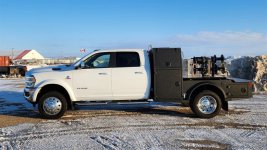
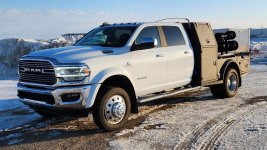
This is a customers truck of a manufacturer i deal with, and this is the bed i am copying to a tee, essentially will be exactly what my setup will look like truck/bed combo. My welding sloop is a big narrower though. This sloop is 48" wide and mine is 36". So the driving factor here is to maintain the ability to still carry my full welding setup to the lake with us, sure i have a dual voltage shop machine i can bring that'll run off 120 or 220v, but its still nice to have generator power OR have ability to do repairs without power.
 

Attachments

  • SO14886 RAM4500 (1).jpg.jpg
    SO14886 RAM4500 (1).jpg.jpg
    141.9 KB · Views: 39
  • 20230324_080058.jpg
    20230324_080058.jpg
    128 KB · Views: 39
Never heard of a Canadian style welding bed. Maybe you could test out the hitch location behind the axle before building the new bed. I doubt if the welding equipment just ahead of the rear axle would balance out the weight of the 5th wheel far behind the rear axle.
 
I think your math lines out and my simple physics/geometry knowledge says it can be done.

But, realistically, having the pivot point and the weight of the trailer be so far behind and above the rear axle is going to cause issues with maneuvering and weight distribution.
 
Yea theres a few varities of welding beds with nicknames out there, pipeliner, texas pipeliner, tub. The saddle cabinet up front type i am building they call a canadian style. And yea deck is being built regardless, the only deciding factor at this time is weather the gooseneck ball gets put over the axle which would require me to remove the welding sloop, or placed further back.

And i agree with you McHenry, i am certainly on the fence and back and forth in my mind about it. To me anyway, i feel that the gooseneck being directly on and above the frame, would be a far stronger and more stable scenario as compared to a conventional receiver hitch on a 3500 drw setup at the max 2000lbs pin 18,000lbs towing, i cant seem to find a 5500 conventional hitch towing rating but it has to be higher than a 3500 drw. Christ i dont think id want to tow 18,000 on a conventional hitch! Another way to look at it maybe, is the further you go back the less payload you have? The further you go fwd the more you have as it translates to front axle weight distribution also.

I dont believe the welding sloop setup + toolbox + aux tank would entirely cancel out the pin weight of the fifth wheel, however it 100% puts weight on the front axle so there would be a give and take there in regards to subtracting some of that pin weight. Its hard to describe until you witness these 5500s in action when it comes to payload. I threw a completed 470 HD bucket on it to deliver to customer after a rebuild, that particular bucket came in at 6300lbs, while i didnt have a tape measure i am not even sure i saw the truck squatted 1.5" when we set it on my bed its nuts
 
The weight forward of the axle will help some with overall weight distribution, but the 5th wheel will have the same cantilever effect on reducing front axle weight with or without the welding equipment.

Statically the truck won’t care, but what about handling over rough winding roads? A 5th wheel can add/subtract a lot of weight, but so can the heavy conventional trailer you mentioned. A WDH is recommended for a conventional trailer of that weight, which is something you can’t do with a 5th wheel. The WDH has a big impact on reducing the weight lost from the front axle on rough roads.

It appears the conventional hitch is only rated for 10K lbs on a C&C. Which is a little surprising, but C&C’s are more about high GVW and less about GCW. Are there OEM conventional hitches on a C&C? Or are they all aftermarket?

IMG_6898.jpeg

At the end of the day I’m not sure I would want to do it often, but if it’s infrequent towing it may not be bad.
 
I feel like you already know the answer from the Austin Ross set up. While not ideal, it's gonna be better than 99% of every welder that has to deal with these weights and are confident that an F350 dually is the ultimate answer when you know the numbers say not. It's just part of the life/job that is hard to reconcile, haul your house to where the job is with a ready-to-work rig aren't 100% compatible things. Judging from previous posts I've read from you I think you are a thoughtful professional making the best decisions you can, this thread included. My 2 cents...go for it.
 
My two cents.. I would never for two reasons. One is just the physics of it - hit a nice frost heave and I could see the front wheels leaving the ground if the trailer pushes down hard. The second is how confident are you in the frame back there? I know how thick it is, I have a 4500 with the same frame, but the web isn't all that tall once you get back to the rear end of it. The 5th wheel/gooseneck being right over the axle is a nice bridge between the spring mounts. A ball towards the back you're going to have no support at the rear, just a pivot off of the rear spring hanger.

That all said - I'd be curious to know who built the bed on that white truck in your post. I need a backpack/saddle cabinet like that and am debating on whether to build it myself or farm it out. That's a slick looking cabinet.
 
I feel like you already know the answer from the Austin Ross set up. While not ideal, it's gonna be better than 99% of every welder that has to deal with these weights and are confident that an F350 dually is the ultimate answer when you know the numbers say not. It's just part of the life/job that is hard to reconcile, haul your house to where the job is with a ready-to-work rig aren't 100% compatible things. Judging from previous posts I've read from you I think you are a thoughtful professional making the best decisions you can, this thread included. My 2 cents...go for it.
thankyou sir i appreciate the kind words, i try my best. I have a pretty solid background in hauling heavy but i by no means consider myself a professional in that particular field. I do enjoy posting these sorts of questions on here to get a nice debate going to get others opinions, because its really sort of an off the wall non conventional idea, even though it has been widely used. Heres a quick pic of austin ross's setup, and those open ranges are heavy well built units. He is literally on the very edge of his welding bed though i remember seeing his hitch location during a rig tour. Too be honest, ive seen worse sag on some 3/4 tons hooked upto some of these bigger units.


GPR, i see your point of view in regards to hitting a decent hole, which in canada seems like every 10 feet. and having the weight of the trailer pushing down behind the wheels versus on the wheels, that certainly would become a decent pivot point, i wondering though with the significant weight of the truck sitting at about 13,500lbs, and all that weight of the tool box/welder etc if that would eliminate that. All speculation of course at this point. As for frame thickness and depth i 100% know what your saying! but even closer to the back of the truck its still far superior to that of its 3500 drw counter part even at its thickest point depth wise. The frame rails on those trucks are paper thin! So i would still feel confident creating a gooseneck super structure at that location.

As for the picture that is ACE manufacturing out of saskatoon, saskatchewan, they do extremely high end work. That deck there though would run ya 35,000$ + as for the cabinet i can imagine it would be around that 10-15,000$ mark. Great company! and i highly recommend them.


as for frequency of towing, i suppose its a relevent comment. Ive some what decommissioned our large 40FT gooseneck, and use a 24ft bumper pull for our business now just for ease of use mostly, the gooseneck is a tank that we generally use for our heavy equipment. So this gooseneck on the truck would almost soely be used for pulling our fifth wheel 3-4 times a year, 100-400km at a time. Again i am not stuck at all ! i can very easily put the ball in the correct location or close to i would just have to remove the welding sloop in order to pull the camper which is not the end of the world, just somewhat inconvenient as described in original post.

I keep going back to the conventional towing picture in my head of 18k lbs behind the truck which dosent make sense to me at all, as a trailer of that weigh should have a pin of 3600lbs some of RAMs numbers make zero sense, some trucks claim they can TOW 20,000lbs on a 3/4 ton, but the payload is under 3,000lbs? wtf. Anyway they claim 18k with a WD hitch which of translates pressure to the front axle. it makes me question how much force is that WD system putting on the front axle at the very rear of the truck, as to compared to having the ball say 24" back towards the rear axle, how much pressure does that translate to the front axle. Iam getting too deep lol.
 

Attachments

  • maxresdefault.jpg
    maxresdefault.jpg
    184.1 KB · Views: 19
Don’t forget that tow ratings are deceitful, with minimal tongue or pin weight and zero cargo or passenger weight. So a conventional trailer at 20000lbs would have 2000lbs of tongue weight for ratings purposes…even thou we all know that it would tow best at 2,600-3,000 lbs of tongue weight.

Your comment of 20K conventional with 3.6K pin weight is mixing terms. Conventional means bumper pull and pin weight means 5th or GN. 3,600 is 18% pin weight which puts you into the light category for 5th/GN pin weights.
 
Last edited:
That is an important point @AH64ID.. I am going to be bumper towing an 18-20k trailer with my 4500. I don't expect pin weight to exceed 2k-ish. And if you use a WD hitch, that is essentially transferring weight forward on the truck (bad description really, but it's too early here) sort of bridging the load forward.
 
That is an important point @AH64ID.. I am going to be bumper towing an 18-20k trailer with my 4500. I don't expect pin weight to exceed 2k-ish. And if you use a WD hitch, that is essentially transferring weight forward on the truck (bad description really, but it's too early here) sort of bridging the load forward.

I wouldn’t want to bumper tow a 18-20K trailer with only 2K on the tongue, that’s too light. 10% is the minimum, but it’s not nearly as stable as 13-15%. There are some exceptions, like boats.
 
thanks for the correction GP, was getting late and i was mixing my terms. Yes with a conventional trailer, the 15-20% should still apply. So the 3600lbs of tougne weight at 18k should be where your at +/- a couple hundred pounds safety wise, triple axle trailer or not, but iam not going to be the weight police as you said to each there own and whatever works.

So went into my cnc program and linked together all my parts that goto my plasma table for deck. Put my sloop ontop of the deck and it looks like best case scenerio i can get 12" of room between the sloop and where it starts to taper back down to the work platform. So where you see that funky ball there i think would be the only place for it to go common sense wise. I believe 12" of room may be enough to run the goosenbox i am not sure. Should allow for decent turning as well camper wise. The location of the ball at this point is 25" behind the axle.
 

Attachments

  • thumbnail_IMG_5414.jpg
    thumbnail_IMG_5414.jpg
    552 KB · Views: 7
A conventional is supposed to be 10-15%
(13-15% preferred) and a GN/5er 15-25% (20-25% preferred).

I’ve towed bumper pulls at 17% TW and they are super stable but the hitch wasn’t rated for that much TW so I had to redistribute the weight and dropped it to 15%.

The higher the tongue or pin weight the more stable the trailer tows. The leading cause of trailer sway is insufficient tongue/pin weight.

Is there anyway to run the ball that far back now? That way you can test it out before committing on the new bed?
 
Back
Top