What's new
Ram Heavy Duty Forum

Register a free account today to become a member! Once signed in, you'll be able to participate on this site by adding your own topics and posts, as well as connect with other members through your own private inbox!

Did I order the wrong truck for a 5th wheel?

Status
Not open for further replies.

Jay D

New Member
Messages
1
Reaction score
0
Points
1
Just placed an order for a 2020 Ram 2500 with the cummins motor, crew cab, 8ft bed, air ride, etc. Payload seems to be around 2200 or so with a 17,000 pound tow capacity. I'm looking to tow a fifth wheel with a pin weight of around 2,000 and a 15,000 pound gross weight? Will the 2500 pull it without an issue, or does the rule (which I'm not sure how to calculate) of not nearing your capacity rule out safely pulling a 5er of that weight class?

Second question would be how much of a difference am I going to have changing the order to a 3500 rather than a 2500 in terms of fuel economy and ride quality? (Both with the same packages.)
 
My 5th wheel maxed weigh was 12k. I pulled it fine at 11.5k and the reig was under weight s. I was within 500 or GAWR. Front had more capacity available. Total rig was 21.5 k. my 2013 RAM 2500 Tradesman CC Diesel had over 2400 payload. Higher trims had 10-20% less.

I know my next trailer will be heavier and perhaps longer. So I bought a 2020 RAM 3500 CC Diesel DRW. Now up to 18k I am confident. A 20k trailer I'd have to research, but probably in my upper range. And again, My Tradesman had 10-20% higher payload than the higher trims do.
 
Last edited:
The 3500 will ride rougher, it has stiffer suspension to carry the extra weight/payload. Unfortunately you need to choose one or the other, I wouldn't pull that 5w with the specs as you ordered them.
 
Once you factor in the cargo (passengers, bags, hitch), you will be way over payload.

Either go 2500 with HEMI (still borderline for 5th) or 3500.

The 3500 SRW will have same fuel economy as the 2500, unless you also go for the HO.

Ride quality: it depends on what you are used to. My 2020 3500 DRW with rear air suspension is very comparable to my previous 2008 2500. Maybe smoother actually.
 
Just placed an order for a 2020 Ram 2500 with the cummins motor, crew cab, 8ft bed, air ride, etc. Payload seems to be around 2200 or so with a 17,000 pound tow capacity. I'm looking to tow a fifth wheel with a pin weight of around 2,000 and a 15,000 pound gross weight? Will the 2500 pull it without an issue, or does the rule (which I'm not sure how to calculate) of not nearing your capacity rule out safely pulling a 5er of that weight class?

Second question would be how much of a difference am I going to have changing the order to a 3500 rather than a 2500 in terms of fuel economy and ride quality? (Both with the same packages.)
Perhaps consider pulling a TT instead. Tongue weight doesn't eat up PL like 5th wheel pin weight.
 
Tongue weight doesn't eat up PL like 5th wheel pin weight.

Your going to have to explain this one to me. A pound of tongue/pin weight is a pound. 1,000 lbs is 1,000 lbs... pin or tongue.

A TT will typically have less tongue weight percentage for a given gross trailer weight (10-13%) compared to a 5th wheel that will have 15-20% pin weight. But both tongue and pin weights as well as hitch weights are absolutely counted against payload.

They really shouldn't even make a diesel 2500. It is a dumb build when you can barely out class my 2019 F-150 CC/LB 3.5L Eco 10 Speed with HD payload package and max tow package....This 1/2 ton truck that has just under 2100 payload and just under 13,000 lbs max trailer. The payload limitations of the diesel 3/4 tons cripples them, assuming you care about things like ratings. My gasser Ram 2500 is rated around 3K payload and around 14K trailer. Even that is not a big jump above the Ford, and the Ford 3.5L Ecoboost would eat my Ram's lunch right off of it's plate during a long hard pull up a mountain. The Eco is a beast. The Ram is heavy and man handles the weight of a mini excavator (9200 lbs) or large skid steer (10,400 lbs) better.

The 2500 diesel will pull in beast mode, but weight wise your screwed unless you ignore the manufactures placards.
 
@Lary0071 I think what he meant is a travel trailer will have less tongue weight than a 5th wheel will have Pin weight. You took it out of context, or at least read into it too much. He meant (or atleast this is how he should have meant it) a 10000 lb bumper pull will have about 1200lbs of tongue weight were a 10000 lb 5th wheel will have about 2000lb pin weight meaning a similar TT will use less payload than a similar 5th wheel.
 
Last edited:
@Lary0071 I think what he meant is a travel trailer will have less tongue weight than a 5th wheel will have Pin weight. You took it out of context. He meant a 10000 lb bumper pull will have about 1200lbs if tongue weight were a 10000 lb 5th wheel will have about 2000lb tongue weight
Sorry, I took it for what he said... That tongue weight doesn't eat up payload.

I was very clear in stating that for a given total trailer weight, you'll have a higher pin weight on fifth vs a TT of the identical weights.


Sent from my SM-N960U using Tapatalk
 
Your going to have to explain this one to me. A pound of tongue/pin weight is a pound. 1,000 lbs is 1,000 lbs... pin or tongue.

A TT will typically have less tongue weight percentage for a given gross trailer weight (10-13%) compared to a 5th wheel that will have 15-20% pin weight. But both tongue and pin weights as well as hitch weights are absolutely counted against payload.
I was implying if you took a TT and 5er with the same GVWR, the TT PL requirement would be less would it not? I didn't imply tongue weight isn't counted against PL.
 
Actually that's exactly what you said. that's why I responded the way I did about travel trailer as having 10 to 12% tongue weight of the gross weight compared to fifth wheels having 15 to 20% pin weight of the gross weight. because your statement was very clear based on the English language, you stated that tongue weight doesn't count against payload. It's fine we all make mistakes while talking online.

Sent from my SM-N960U using Tapatalk
 
@Jay D I had the same dilemma, 2500 for comfort, or 3500 for keeping towing options open later on down the road. This Youtube video convinced me to go with the 3500: 2500 vs 3500. The point is, the 2500 will probably do just fine, but IF something bad happens, you and your insurance company will very quickly regret you not having a properly rated truck.

As for comfort, Interestingly enough, my test drives in both the 2500 & 3500 weren't much different in ride quality. When I took delivery of the 3500, she had 90 psi in all 4 tires and the ride was horrible. dropping down the factory tires to 45 psi in the front, and 40 in the rear made a substantial difference (just daily driving - towing, I raised the psi's into the 60's). After leveling with new springs and 35's the ride got even better. I have the factory air assist, and there is a way to adjust the sensors to further improve the ride.

Don't roll the dice, do it right the first time.
 
Actually that's exactly what you said. that's why I responded the way I did about travel trailer as having 10 to 12% tongue weight of the gross weight compared to fifth wheels having 15 to 20% pin weight of the gross weight. because your statement was very clear based on the English language, you stated that tongue weight doesn't count against payload. It's fine we all make mistakes while talking online.

Sent from my SM-N960U using Tapatalk
This is what I wrote. "Perhaps consider pulling a TT instead. Tongue weight doesn't eat up PL like 5th wheel pin weight." Show me where in this statement I said tongue weight doesn't count against payload? You're right, we have a different interpretation of the English language and I clarified my statement by saying as compared with the same gross vehicle weight rating.
 
Let's think about how these disagreements benefit the OP and keep the conversation on point. No need to get your knickers in a bunch over semantics. The passive-aggressive replies are not helpful to the OP.

Bottom line, while it's well understood the 2500 "probably" has more capability payload wise (rear GAWR is the real measure), it's not legal per the door sticker if that concerns you.

GM is pushing their 2500 GVWR to 11300 (?) and GAWR on the rear to 6600 so the capacity is there - although they are leaf sprung FWIW.

I ran well over my punching weight for 16 years without issue. I assumed that risk but regretted not getting a 3500 when I had the chance. Had I done so, there's a good chance I may have kept the truck.

I think the OP's question has been answered so let's go easy and not burn this thread down. If @Jay D has any specific questions, I'm sure he'll ask.
 
Your going to have to explain this one to me. A pound of tongue/pin weight is a pound. 1,000 lbs is 1,000 lbs... pin or tongue.

A TT will typically have less tongue weight percentage for a given gross trailer weight (10-13%) compared to a 5th wheel that will have 15-20% pin weight. But both tongue and pin weights as well as hitch weights are absolutely counted against payload.

They really shouldn't even make a diesel 2500. It is a dumb build when you can barely out class my 2019 F-150 CC/LB 3.5L Eco 10 Speed with HD payload package and max tow package....This 1/2 ton truck that has just under 2100 payload and just under 13,000 lbs max trailer. The payload limitations of the diesel 3/4 tons cripples them, assuming you care about things like ratings. My gasser Ram 2500 is rated around 3K payload and around 14K trailer. Even that is not a big jump above the Ford, and the Ford 3.5L Ecoboost would eat my Ram's lunch right off of it's plate during a long hard pull up a mountain. The Eco is a beast. The Ram is heavy and man handles the weight of a mini excavator (9200 lbs) or large skid steer (10,400 lbs) better.

The 2500 diesel will pull in beast mode, but weight wise your screwed unless you ignore the manufactures placards.
I personally would never load a 1500 up to 13k and feel safe but a 2500 can definitly handle up to 17k with out any trouble an be safe. My 16 ram 6.7 rfe was capable oon 17,200. I regularly hauled 13k and 15k on occasion. It handled it with ease. I loved that truck , was An awesome machine. The only reason o bought the 3500 was because we plan on hauling almost double or current weight. The fuel millage definitly sucks on the 3500 vs 2500. My averages are
w tow. 3500 vs 2500. At 75mph
9-10. 11-13

W/o tow 3500 vs 2500. At 75mph
12-15. 21-28
MY current 13k fiver has pin/ tongue weight of 2500'lbs and the 16 2500 didn'teven squat. The 2500 was also much easier to get around town as well. I'm jaded on this decision as i do wish i got the 3500 from the git go to save going through the wholes process again but there is just know way to know what you may need in the future. If your lucky enough to know that you won't ever be hauling over the 17 k than i would personally stick with the 2500 just due to the fuel savings and the ease of maneuverability alone. These opinions are solely based on my experience of owning both 3/4 & 1 ton. Only you know what's best for your needs and what the future may hold.
 
The 3500 will ride rougher, it has stiffer suspension to carry the extra weight/payload. Unfortunately you need to choose one or the other, I wouldn't pull that 5w with the specs as you ordered them.
I must admit to not having driven a 2500, but my 3500 is at least as smooth, if not smoother, than my 2010 F250 ever was. I am quite impressed with the ride and handling of my monster (it is big and tall!) 3500!
 
I must admit to not having driven a 2500, but my 3500 is at least as smooth, if not smoother, than my 2010 F250 ever was. I am quite impressed with the ride and handling of my monster (it is big and tall!) 3500!
That air ride suspension makes it ride awesome, definitly doesnt compare to my old 96 dodge drw. That thing was a log truck. With the new 20 model, when empty, the front axle goes over bumps like a car, barely any jolt at all, the big drw rear axle is not so forgiving but way way way better than the old school drw
 
Regardless of what the “legal” carrying capacity is, I regularly carry 5th wheels over 14,000lbs with 90 gallons of fuel and 500lbs of hitches and tools in the bed. As long as the rating of the tires is not exceeded, DOT doesn’t care one iota as long as I am not over my registered weight. These numbers provided by the manufacturer seem real low to protect them from liability. Fire retardant suit is on, flame me now. On a side note, I do have air bags to level and control the load.
 
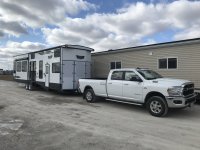
This travel trailer weighed 13,200lbs empty with a tongue weight of 1,920lbs. Hate pull them but someone has to do it.
 

Attachments

  • 68ECF268-DF61-4931-A8C8-7BEF1ABB583C.jpeg
    68ECF268-DF61-4931-A8C8-7BEF1ABB583C.jpeg
    475.8 KB · Views: 56
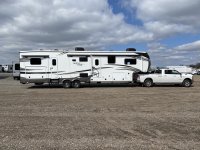
This 5th wheel weighed 14,800lbs empty. Pin weight of 2,900lbs. I was actually over-weight when I started but burned enough fuel by the time I hit the first scale.
 

Attachments

  • 811D1B54-AE9F-4022-9986-27FEDA9BA67F.jpeg
    811D1B54-AE9F-4022-9986-27FEDA9BA67F.jpeg
    800.3 KB · Views: 70
Status
Not open for further replies.
Back
Top