
tcedgar8
Member
- Messages
- 54
- Reaction score
- 69
- Points
- 18
Hey folks Just thought I'd share some industries experience and thoughts on the intake manifolds and possible conditions they can have.
I recently did a weight loss program on the 19' HO Cummins and I'm stumped why I didn't do this earlier. 75 more HP and an a crazy gain in fuel economy.
Anyways we got a problem that I notice wasn't directly documented when I was searching for in our forms or some others. Obviously we know the EGR is as good if not better than sniffing your own farts, its bad for you!!!! I preformed my weight loss on the engine about 3000km after the initial update. Truck has 100000km total so it had an unhealthy 100000km.
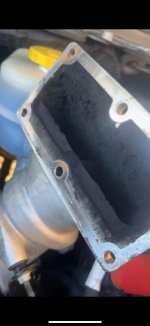
I had the intake horn removed and noted 1/8"-1/4" of soot in the intake elbow and on top of the grid heater. This was somewhat interesting to me as the truck as very low idle hours and low overall hours compared previous 6.7 engines ran in heavy equipment and other larger trucks. Typically the major issue faced with the soot build up is when it becomes hard(Coking). Once it migrates into the combustion chamber it damages the rings and scores the bores. My truck did have an early turbo failure at around 80000km naturally this will have an increase in build up on the material accumulating in the intake, Frankly the majority of oil would just burn off no big deal but the extra soot makes it a mess for sure.
After I assembled the truck I slept on it and couldn't have left that additional soot in the intake manifold. I begrudgingly removed the intake horn and all fuel lines. I cleaned the intake as
I could and verified grid heater hardware torque, the next picture is cleaned.
The Key take aways
- EGR Bad, If you can do a weight loss and your keeping the truck long term its a good Idea. If you're leasing or keeping it short term likely a problem for the next guy.
- with the weight loss done including CCV relocate and the other obvious updates I don't see a need to clean the intake a preventative maintained of course this is a case by case as everyone has different goals and tolerance for updates to there vehicle. If for some reason I kept my truck factory i would likely clean the intake once a year as premature engine failure wouldnt surprise me. The process was maybe 2 hours for me with a somewhat rag tag tool set compared to what I'm use to.
Just some thoughts and info for guys let me know with question's or experience of youre own.

I recently did a weight loss program on the 19' HO Cummins and I'm stumped why I didn't do this earlier. 75 more HP and an a crazy gain in fuel economy.
Anyways we got a problem that I notice wasn't directly documented when I was searching for in our forms or some others. Obviously we know the EGR is as good if not better than sniffing your own farts, its bad for you!!!! I preformed my weight loss on the engine about 3000km after the initial update. Truck has 100000km total so it had an unhealthy 100000km.
I had the intake horn removed and noted 1/8"-1/4" of soot in the intake elbow and on top of the grid heater. This was somewhat interesting to me as the truck as very low idle hours and low overall hours compared previous 6.7 engines ran in heavy equipment and other larger trucks. Typically the major issue faced with the soot build up is when it becomes hard(Coking). Once it migrates into the combustion chamber it damages the rings and scores the bores. My truck did have an early turbo failure at around 80000km naturally this will have an increase in build up on the material accumulating in the intake, Frankly the majority of oil would just burn off no big deal but the extra soot makes it a mess for sure.
After I assembled the truck I slept on it and couldn't have left that additional soot in the intake manifold. I begrudgingly removed the intake horn and all fuel lines. I cleaned the intake as
I could and verified grid heater hardware torque, the next picture is cleaned.
The Key take aways
- EGR Bad, If you can do a weight loss and your keeping the truck long term its a good Idea. If you're leasing or keeping it short term likely a problem for the next guy.
- with the weight loss done including CCV relocate and the other obvious updates I don't see a need to clean the intake a preventative maintained of course this is a case by case as everyone has different goals and tolerance for updates to there vehicle. If for some reason I kept my truck factory i would likely clean the intake once a year as premature engine failure wouldnt surprise me. The process was maybe 2 hours for me with a somewhat rag tag tool set compared to what I'm use to.
Just some thoughts and info for guys let me know with question's or experience of youre own.