Ram Heavy Duty Forum
You are using an out of date browser. It may not display this or other websites correctly.
You should upgrade or use an alternative browser.
You should upgrade or use an alternative browser.
What did you do TO your RAM today?
- Thread starter LamboTexas
- Start date

- Messages
- 5,221
- Reaction score
- 5,434
- Points
- 113
Has the chalk test been mentioned? I use several factors but chalk test seems to yield the best results for me over the years
It’s been mentioned in several threads, can’t recall if it’s been mentioned in this one.
It kinda works, but isn’t anywhere near as accurate as load/inflation tables. The chalk test can easily leave you overinflated or underinflated depending on a host of factors.
Loaded I go with inflation tables but unloaded use chalk and monitor tire wear.It’s been mentioned in several threads, can’t recall if it’s been mentioned in this one.
It kinda works, but isn’t anywhere near as accurate as load/inflation tables. The chalk test can easily leave you overinflated or underinflated depending on a host of factors.

ThreeBearsHD
Well-Known Member
- Messages
- 132
- Reaction score
- 489
- Points
- 63
I changed my oil for the first time at 3600 miles. Used a FleetGuard oil filter and Rotella T6 5-40.
I don't know why, but every first oil change on my new Stellantis vehicles has been a disaster. On my 2024 Jeep Wrangler, the oil filter was cross-threaded from the factory. It was a freaking nightmare...
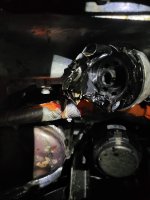

This oil change was not as bad, but still took two hours.
I started it during the daylight and at 55 degrees with cloudy skies. I finished it at night with pouring rain and 40 degrees.
I got the oil pan plug out with no issues and the oil drained just fine. I let it drain for 45 minutes or so while I tried to get the filter off. First issue; none of my oil filter wrenched would fit since I was outfitted for motorcycles and Toyotas. Filter would not budge. Tried my large pipe wrench and not enough room or adjustment. Tried some large C-clamps, but again no room. Then I tried hammering the filter flatter so maybe the pipe wrench would fit. Nope.
I reluctantly resorted to the nuclear option of pounding a larger Philips screwdriver through the filter. Even then, I had to put a pry bar on the screw driver handle to get enough leverage to break the filter loose. Got the old filter out, then filled the new filter up, used my special filter plug tool to maneuver back into the space, oiled up the gasket, and then took me another 15 minutes to get the filter to start threading onto the housing. Got it on, gave it another 3/4 turn after the gasket made contact, and wiped down everything and cleaned up my mess.
Then it was finally time to put in the new oil...
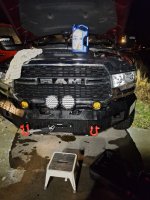
I started filling it via my funnel and didn't realize that the oil was flowing so slow, so the funnel filled up, then my hand slipped, and the funnel tipped over and spilled about 2 quarts of oil all over the top of the engine. In the photo above, the large clear pool under the truck is the spilled fresh oil.
It got all over the belts and front of the motor...

I wiped off as much as I could with a towel. I finished filling the engine, started it for about 15 seconds, then let it sit for a minute or two and checked the level. It is just below the SAFE level, but the pressure was 50 psi at idle. My plan was to drive it the 3 blocks to the car wash and spray the motor down, then head to the larger town and get another couple of quarts of oil. I'll do the next oil change at the 7500-mile mark and have the dealer do it and let them do the fuel filters.
I don't know why, but every first oil change on my new Stellantis vehicles has been a disaster. On my 2024 Jeep Wrangler, the oil filter was cross-threaded from the factory. It was a freaking nightmare...
This oil change was not as bad, but still took two hours.
I started it during the daylight and at 55 degrees with cloudy skies. I finished it at night with pouring rain and 40 degrees.
I got the oil pan plug out with no issues and the oil drained just fine. I let it drain for 45 minutes or so while I tried to get the filter off. First issue; none of my oil filter wrenched would fit since I was outfitted for motorcycles and Toyotas. Filter would not budge. Tried my large pipe wrench and not enough room or adjustment. Tried some large C-clamps, but again no room. Then I tried hammering the filter flatter so maybe the pipe wrench would fit. Nope.
I reluctantly resorted to the nuclear option of pounding a larger Philips screwdriver through the filter. Even then, I had to put a pry bar on the screw driver handle to get enough leverage to break the filter loose. Got the old filter out, then filled the new filter up, used my special filter plug tool to maneuver back into the space, oiled up the gasket, and then took me another 15 minutes to get the filter to start threading onto the housing. Got it on, gave it another 3/4 turn after the gasket made contact, and wiped down everything and cleaned up my mess.
Then it was finally time to put in the new oil...
I started filling it via my funnel and didn't realize that the oil was flowing so slow, so the funnel filled up, then my hand slipped, and the funnel tipped over and spilled about 2 quarts of oil all over the top of the engine. In the photo above, the large clear pool under the truck is the spilled fresh oil.
It got all over the belts and front of the motor...
I wiped off as much as I could with a towel. I finished filling the engine, started it for about 15 seconds, then let it sit for a minute or two and checked the level. It is just below the SAFE level, but the pressure was 50 psi at idle. My plan was to drive it the 3 blocks to the car wash and spray the motor down, then head to the larger town and get another couple of quarts of oil. I'll do the next oil change at the 7500-mile mark and have the dealer do it and let them do the fuel filters.

I changed my oil for the first time at 3600 miles. Used a FleetGuard oil filter and Rotella T6 5-40.
I don't know why, but every first oil change on my new Stellantis vehicles has been a disaster. On my 2024 Jeep Wrangler, the oil filter was cross-threaded from the factory. It was a freaking nightmare...
View attachment 90649
View attachment 90650
This oil change was not as bad, but still took two hours.
I started it during the daylight and at 55 degrees with cloudy skies. I finished it at night with pouring rain and 40 degrees.
I got the oil pan plug out with no issues and the oil drained just fine. I let it drain for 45 minutes or so while I tried to get the filter off. First issue; none of my oil filter wrenched would fit since I was outfitted for motorcycles and Toyotas. Filter would not budge. Tried my large pipe wrench and not enough room or adjustment. Tried some large C-clamps, but again no room. Then I tried hammering the filter flatter so maybe the pipe wrench would fit. Nope.
I reluctantly resorted to the nuclear option of pounding a larger Philips screwdriver through the filter. Even then, I had to put a pry bar on the screw driver handle to get enough leverage to break the filter loose. Got the old filter out, then filled the new filter up, used my special filter plug tool to maneuver back into the space, oiled up the gasket, and then took me another 15 minutes to get the filter to start threading onto the housing. Got it on, gave it another 3/4 turn after the gasket made contact, and wiped down everything and cleaned up my mess.
Then it was finally time to put in the new oil...
View attachment 90651
I started filling it via my funnel and didn't realize that the oil was flowing so slow, so the funnel filled up, then my hand slipped, and the funnel tipped over and spilled about 2 quarts of oil all over the top of the engine. In the photo above, the large clear pool under the truck is the spilled fresh oil.
It got all over the belts and front of the motor...
I wiped off as much as I could with a towel. I finished filling the engine, started it for about 15 seconds, then let it sit for a minute or two and checked the level. It is just below the SAFE level, but the pressure was 50 psi at idle. My plan was to drive it the 3 blocks to the car wash and spray the motor down, then head to the larger town and get another couple of quarts of oil. I'll do the next oil change at the 7500-mile mark and have the dealer do it and let them do the fuel filters.
Be aware the oil PSI is calculated by the ECU. These trucks don't have a real pressure sensor. It's on on/off pressure sensor only.
- Messages
- 5,221
- Reaction score
- 5,434
- Points
- 113
Be aware the oil PSI is calculated by the ECU. These trucks don't have a real pressure sensor. It's on on/off pressure sensor only.
Just as fake as oil temp…. Still infuriates me
That was a bad day for sure. You can wash motor down with a can of gunk, wash off and spray engine with silicone spray. It will look new again.I changed my oil for the first time at 3600 miles. Used a FleetGuard oil filter and Rotella T6 5-40.
I don't know why, but every first oil change on my new Stellantis vehicles has been a disaster. On my 2024 Jeep Wrangler, the oil filter was cross-threaded from the factory. It was a freaking nightmare...
View attachment 90649
View attachment 90650
This oil change was not as bad, but still took two hours.
I started it during the daylight and at 55 degrees with cloudy skies. I finished it at night with pouring rain and 40 degrees.
I got the oil pan plug out with no issues and the oil drained just fine. I let it drain for 45 minutes or so while I tried to get the filter off. First issue; none of my oil filter wrenched would fit since I was outfitted for motorcycles and Toyotas. Filter would not budge. Tried my large pipe wrench and not enough room or adjustment. Tried some large C-clamps, but again no room. Then I tried hammering the filter flatter so maybe the pipe wrench would fit. Nope.
I reluctantly resorted to the nuclear option of pounding a larger Philips screwdriver through the filter. Even then, I had to put a pry bar on the screw driver handle to get enough leverage to break the filter loose. Got the old filter out, then filled the new filter up, used my special filter plug tool to maneuver back into the space, oiled up the gasket, and then took me another 15 minutes to get the filter to start threading onto the housing. Got it on, gave it another 3/4 turn after the gasket made contact, and wiped down everything and cleaned up my mess.
Then it was finally time to put in the new oil...
View attachment 90651
I started filling it via my funnel and didn't realize that the oil was flowing so slow, so the funnel filled up, then my hand slipped, and the funnel tipped over and spilled about 2 quarts of oil all over the top of the engine. In the photo above, the large clear pool under the truck is the spilled fresh oil.
It got all over the belts and front of the motor...
View attachment 90653
I wiped off as much as I could with a towel. I finished filling the engine, started it for about 15 seconds, then let it sit for a minute or two and checked the level. It is just below the SAFE level, but the pressure was 50 psi at idle. My plan was to drive it the 3 blocks to the car wash and spray the motor down, then head to the larger town and get another couple of quarts of oil. I'll do the next oil change at the 7500-mile mark and have the dealer do it and let them do the fuel filters.

Fantastipotamus
Active Member
I'll be honest, I very much do not like taking my truck to the dealership for something as stupid as an oil change, it feels completely ridiculous.. then I read a recounting like this, and decide that.. actually, maybe I'm okay with it.This oil change was not as bad, but still took two hours.
...
I started filling it via my funnel and didn't realize that the oil was flowing so slow, so the funnel filled up, then my hand slipped,
Whomever collectively decided changing your own oil should be a huge pain in the ass ought to be forced to change oil in these vehicles for the rest of their lives. Shameful design (and RAM definitely not the only ones).
- Messages
- 5,221
- Reaction score
- 5,434
- Points
- 113
I'll be honest, I very much do not like taking my truck to the dealership for something as stupid as an oil change, it feels completely ridiculous.. then I read a recounting like this, and decide that.. actually, maybe I'm okay with it.
Whomever collectively decided changing your own oil should be a huge pain in the ass ought to be forced to change oil in these vehicles for the rest of their lives. Shameful design (and RAM definitely not the only ones).
There really isn’t anything difficult about changing the oil on these trucks, and when you do it yourself you know it’s done right. It’s doubtful that the oil change techs, they aren’t usually mechanics, at the dealership even let the oil drain long enough.
Fantastipotamus
Active Member
This is very fair - and truth be told, my local dealership didn't drain the oil in my old truck before adding the new, so i ran double the oil capacity for a few days. Thankfully i noticed the little puff of smoke at every startup, and brought it back in (no damage done).There really isn’t anything difficult about changing the oil on these trucks, and when you do it yourself you know it’s done right. It’s doubtful that the oil change techs, they aren’t usually mechanics, at the dealership even let the oil drain long enough.
In this particular case with this truck, the dealer where I bought also maintains a 'lifetime engine warranty' as long as I get my oil changed there.. so while it would be a huge pain, if they f it up, they'll be the ones swapping the engine out at their cost.

BigHorn3500
Active Member
I am going to lower my pressure's today it does ride hard . I can always increase them when I'm going to tow . It's a good idea thank's

Razzman
Well-Known Member
I've used the chalk test for decades and it's never failed me. 63 front & 50 rear unloaded. Towing I bump to 65 F&R. Too many factors to rely solely on inflation tables, tire size, width, wheel width, truck specifics and how it's used all play a role in determining proper inflation.
The people who design the sideways or upside down spin on filter deserve a special place in hell. It certainly used to be easier, my 1990 Cummins was a breezeI'll be honest, I very much do not like taking my truck to the dealership for something as stupid as an oil change, it feels completely ridiculous.. then I read a recounting like this, and decide that.. actually, maybe I'm okay with it.
Whomever collectively decided changing your own oil should be a huge pain in the ass ought to be forced to change oil in these vehicles for the rest of their lives. Shameful design (and RAM definitely not the only ones).
- Messages
- 5,221
- Reaction score
- 5,434
- Points
- 113
I've used the chalk test for decades and it's never failed me. 63 front & 50 rear unloaded. Towing I bump to 65 F&R. Too many factors to rely solely on inflation tables, tire size, width, wheel width, truck specifics and how it's used all play a role in determining proper inflation.
But all those factors have an even larger effect on the chalk test and make the chalk test far more of a WAG than published specs from the manufacturers, making it easier to run over or underinflated (often overinflated). The variables mentioned will have a bigger impact on tire wear than load carry capacity, which is the biggest function of the load/inflation tables.
Just looking at your sig and what pressures you mentioned the chalk test has you fairly overinflated unloaded, not really a good sales pitch for the chalk test.
The people who design the sideways or upside down spin on filter deserve a special place in hell. It certainly used to be easier, my 1990 Cummins was a breeze
Oil filter location/orientation was unchanged from 89-24 for the Cummins.
Razzman
Well-Known Member
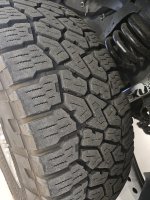
Almost 20 years in the tire industry as well as practical application tells me otherwise. Too many people believe tire inflation charts are the gold standard, they aren't. They are guidelines as well as requirements made to cover the mfgrs butts. Nobody I ever knew in the industry or know now goes by those. Just went and took a pic of my front tire for reference, these Falkens have 35K on them now, and roughly 20K of that is towing the trailer. If you know how to properly read a tire you'll not find one thing wrong here to include over inflation, cupping, camber wear or feathering.But all those factors have an even larger effect on the chalk test and make the chalk test far more of a WAG than published specs from the manufacturers, making it easier to run over or underinflated (often overinflated). The variables mentioned will have a bigger impact on tire wear than load carry capacity, which is the biggest function of the load/inflation tables.
Just looking at your sig and what pressures you mentioned the chalk test has you fairly overinflated unloaded, not really a good sales pitch for the chalk test.
- Messages
- 5,221
- Reaction score
- 5,434
- Points
- 113
Almost 20 years in the tire industry as well as practical application tells me otherwise. Too many people believe tire inflation charts are the gold standard, they aren't. They are guidelines as well as requirements made to cover the mfgrs butts. Nobody I ever knew in the industry or know now goes by those. Just went and took a pic of my front tire for reference, these Falkens have 35K on them now, and roughly 20K of that is towing the trailer. If you know how to properly read a tire you'll not find one thing wrong here to include over inflation, cupping, camber wear or feathering.
View attachment 90656
I will agree that most of the industry doesn't use them, but rather they use the door placard which we all know the intent behind that.... so I can't say that argument is valid or even really worth bringing up. It's why asking for 55/35 on a tire rotation gets funny looks from most the tire shops, but occasionally you get someone who understands and they make a comment or conversation about it.
The industry also doesn't use chalk tests, for good reason.. its a WAG nothing more and nothing less. I used it for years myself but its severely antiquated and implying anything less is laughable.
The tires look great, especially for their miles, but they do appear overinflated.
Razzman
Well-Known Member
If they were overinflated at 35K the center would be worn, they aren't. Sometimes antiquated is till valid. While they may not use it now, we did back in the day when doing custom setups otherwise it's a guessing game. Also, have no clue what a WAG is lol.I will agree that most of the industry doesn't use them, but rather they use the door placard which we all know the intent behind that.... so I can't say that argument is valid or even really worth bringing up. It's why asking for 55/35 on a tire rotation gets funny looks from most the tire shops, but occasionally you get someone who understands and they make a comment or conversation about it.
The industry also doesn't use chalk tests, for good reason.. its a WAG nothing more and nothing less. I used it for years myself but its severely antiquated and implying anything less is laughable.
The tires look great, especially for their miles, but they do appear overinflated.
- Messages
- 5,221
- Reaction score
- 5,434
- Points
- 113
If they were overinflated at 35K the center would be worn, they aren't. Sometimes antiquated is till valid. While they may not use it now, we did back in the day when doing custom setups otherwise it's a guessing game. Also, have no clue what a WAG is lol.
Antiquated can definitely still be useful and valid, just not as good or accurate as modern methods. Sometimes older methods are better, but not always.
WAG is a Wild Arse Guess, which is slightly less accurate than a SWAG.. Sophisticated Wild Arse Guess.
I can't tell the specific wear from the photo, but the tire does have signs of overinflation, can't hide that. The outer ~1/2" of tread on both the inside and outside doesn't have the contact marks the rest of tread does (ironically the chalk test would also show this
 ).
).
Rockcrawlindude
a rock crawlin’ dude
I’m placing a guess. 4000 front 3000 rearIts a hemi, crew cab short bed. Also, thanks for the advice gents! I have a friend who has some scales.

Riz!
Active Member
- Messages
- 104
- Reaction score
- 233
- Points
- 43
@ThreeBearsHD
Thats nuts! My ‘22 1500 was like that and my ‘08 f150. Its like the dman filters were put on woth air wrenches and no oil on the gasket. Luckily my 2500 was put on correctly and came off easily. The 1500 would spill oil from the filter all over steering components.
Thats nuts! My ‘22 1500 was like that and my ‘08 f150. Its like the dman filters were put on woth air wrenches and no oil on the gasket. Luckily my 2500 was put on correctly and came off easily. The 1500 would spill oil from the filter all over steering components.