So I just dumped my Ram Dually diesel (my first diesel and my first dually) for a Hemi powered SRW 3500 truck. Loved the way the diesel drove with all of the torque, but realized the truck I had was WAY too much truck for my needs at this time in my life. Went back to gas for the reduced cost and simplicity. If I could buy a gas motor that acted like a diesel (like the rumored specs of the 6.7 gas motor from Cummins - 325 HP/660 Torque), I would be all over it.
Ram Heavy Duty Forum
You are using an out of date browser. It may not display this or other websites correctly.
You should upgrade or use an alternative browser.
You should upgrade or use an alternative browser.
Cummins 6.7 gas motor
- Thread starter Torqued
- Start date

Rockcrawlindude
a rock crawlin’ dude
Like the 6.4 Hemi?Ford has the right idea. Nothing better than a big N/A old-skool pushrod v8.

I doubt they’ll ever put a “new” big gas engine in the HD Rams. Expect the next big powertrain change to be the addition of the hybrid system that the Ramcharger has. I’ve said it before but it bears repeating here, that truck is 90% of an HD truck already, and I’m confident they did that to use it as a test bed for future HDs.
Dang, I hope you are wrong. If that happens while Ford and GM still offer BGEs in the lower trim levels, Ram can kiss future fleet sales goodbye. I can't think of a reason why a company would sign up for the extra cost and maintenance of a hybrid system when they could just switch brands for their gas truck needs.
Power and torque as high or higher than diesel, fuel economy significant better than diesel (especially for city use, which most fleet use is), and none of the diesel idle or low mileage issues. Sounds like a win for most fleets.Dang, I hope you are wrong. If that happens while Ford and GM still offer BGEs in the lower trim levels, Ram can kiss future fleet sales goodbye. I can't think of a reason why a company would sign up for the extra cost and maintenance of a hybrid system when they could just switch brands for their gas truck needs.

silver billet
Active Member
- Messages
- 122
- Reaction score
- 158
- Points
- 43
Like the 6.4 Hemi?
The 7.3 is technically a "big block". It's also far more powerful than the 6.4. The 7.3 also does not have any form of DOD/MDS. The 6.4 is ok, but its performance is pretty outclassed by the 6.6, 6.8, and 7.3s that are available in this space.
Agree on the 6.8 and 7.3 Fords. The blue oval has the right idea there, no goofy fuel saving systems that cause issues down the road, and port fuel injection. All that and available 4.30 gears. That is a winning combo right there.The 7.3 is technically a "big block". It's also far more powerful than the 6.4. The 7.3 also does not have any form of DOD/MDS. The 6.4 is ok, but its performance is pretty outclassed by the 6.6, 6.8, and 7.3s that are available in this space.
I don't see GM's 6.6 powertrain combo being better than Ram's, as it has its own disadvantages. The L8T makes 35 lb/ft more torque, but a bit less hp, so it is in the ballpark w/the Hemi. GM uses direct fuel injection which has been shown to allow carbon build up on the back of intake valves causing running issues as early as 40K miles. GM also only allows a best of 3.73 gears in their gas trucks. In the Ram, you can still get the 4.10 gears.
Stellantis has a great 8 speed transmission, and they still offer the 4.10 gears, but they are going to HAVE to do something about a HD gas engine if they want to keep up with Ford. If they can figure out a way to bring the 325/660 version of the gas Cummins to market with minimal, or at least a reasonable cost increase, I think that will be a winner.



GirchyGirchy
Member
- Messages
- 56
- Reaction score
- 84
- Points
- 18
Hey, that's where the banner went! It was out for the Stellantis CEO visit, then disappeared. They also had one of the Indy cars out.I bet these guys know what’s happening.
View attachment 77805
Anyone need anything?
View attachment 77806
Did you stop by the HQ to see the little museum?
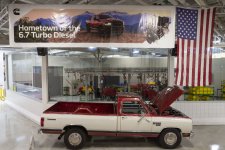

I was there for a memorial and didn’t have time to stop in. I know my grandfather worked there for a long time though.Hey, that's where the banner went! It was out for the Stellantis CEO visit, then disappeared. They also had one of the Indy cars out.
Did you stop by the HQ to see the little museum?
View attachment 78532
View attachment 78533

WildBill138
Active Member
- Messages
- 127
- Reaction score
- 196
- Points
- 43
I've got the 6.4 and its pretty perfect for a SRW 2500. I'm a younger generation it seems as the term v8 is a bit cringy now a days to me and most in the youth track day racecar world. You really want Dual overhead cams and forced induction (like the new mustang and Corvette zr1). So if someone were to make a modern dohc 6 litre turbo gas engine I'd say that would be pretty rad. A v8 would be good, but as a mechanic it's just twice as much to go wrong with two heads for no reason.
You know the Mustang and Corvette have V8s, right?I've got the 6.4 and its pretty perfect for a SRW 2500. I'm a younger generation it seems as the term v8 is a bit cringy now a days to me and most in the youth track day racecar world. You really want Dual overhead cams and forced induction (like the new mustang and Corvette zr1). So if someone were to make a modern dohc 6 litre turbo gas engine I'd say that would be pretty rad. A v8 would be good, but as a mechanic it's just twice as much to go wrong with two heads for no reason.
silver billet
Active Member
- Messages
- 122
- Reaction score
- 158
- Points
- 43
You know the Mustang and Corvette have V8s, right?
Seems to me the issue is his friends and not the v8.
The advantage of forced induction in an inexpensive small engined race car is tuning is cheap and bragging rights my 4-banger beat your old school v8 (once maybe). I race cars and my primary race car is a BMW 550i (v8). In my racing circles I find that most people who are seriously into racing are driving corvettes (probably #1), porche's (probably #2), (mutangs #3), CTV-V's (#4) and they're mostly non-forced induction flat-6 and V8 powered cars. The reason is reliability outside a 1/4 mile track. There is a big difference between 1-2 pulls on a street and sustained high performance driving at a track event for an hour in Texas in over 100F temps.
From talking with tuners, No tuner will tell your tuned forced induction engine is reliable in 100F heat doing mult-minute long sustained full throttle in that heat from a heat soaked start (start line). If you want lots of power under those conditions a bigger engine with low / no boost is preferable. Hence why v8s are a popular choice in pickups. Big displacement low compression/hp engines simply hold up better for running them super hard (like full throttle minutes at a time). Winning a race is also about finishing and breaking down is an automatic DNF!
From talking with tuners, No tuner will tell your tuned forced induction engine is reliable in 100F heat doing mult-minute long sustained full throttle in that heat from a heat soaked start (start line). If you want lots of power under those conditions a bigger engine with low / no boost is preferable. Hence why v8s are a popular choice in pickups. Big displacement low compression/hp engines simply hold up better for running them super hard (like full throttle minutes at a time). Winning a race is also about finishing and breaking down is an automatic DNF!
Last edited:
silver billet
Active Member
- Messages
- 122
- Reaction score
- 158
- Points
- 43
If you want lots of power under those conditions a bigger engine with low / no boost is preferable. Hence why v8s are a popular choice in pickups. Big displacement low compression/hp engines simply hold up better for running them super hard (like full throttle minutes at a time). Winning a race is also about finishing and breaking down is an automatic DNF!
You know I used to think this as well and it's probably true in a general case. But I saw the TFL torture test where the new hurricane SO got the least hot, my 5.7 stock would have overheated on that test. Maybe that's just poor tuning on Ram's part? But in any case, you can make either v8 or turbos hotter or cooler if you know what you're doing, its all the implementation.

Poolmonkey
Well-Known Member
No thanks, no forced induction please.Who would be interested in a Cummins 6.7 gas if it made 450 hp at 2800 rpm and 850 lbs torque at 1800 rpm. Finally a motor without too much emmisions crap.
Cooling is definitely an issue as well.. The hardest thing to do while towing is full throttle at slow speeds where your generating maximum heat and have minimal airflow for cooling. I've seen the TFL series and its is a test of cooling system / engine tuning and not really a test of forced induction vs naturally aspirated as you observed. We'll wait to see Andre use his new to him 5.7 tundra to do the same test next summer.You know I used to think this as well and it's probably true in a general case. But I saw the TFL torture test where the new hurricane SO got the least hot, my 5.7 stock would have overheated on that test. Maybe that's just poor tuning on Ram's part? But in any case, you can make either v8 or turbos hotter or cooler if you know what you're doing, its all the implementation.
The issue I'm referring to indirectly above about racing conditions is LSPI (low-speed Pre-Ignition). IT a real problem on boosted engines with direct injection. Especially with oil in the combustion chamber from the turbo and PCV system and that are tuned.
I would still argue for work trucks that are cheap to maintain a large naturally asparated gas v8 is preferable to a downsized boosted engine, for simplicity, cost and reliability. Given the significant increase in complexity of the hurricane engine over the 6.4, I'd be surprised if its as cheaper to maintain for a fleet owner. I just think of all those extra plastic coolant lines to the turbo, oil lines, extra coolers. I've always had problems with those items on higher milage turbo gasoline cars. No one really cares if your valve cover or oil pan leaks (unless oil drips are a no-no), but turbo line leaks are a big problem and often a pain to fix.
Last edited:
WildBill138
Active Member
- Messages
- 127
- Reaction score
- 196
- Points
- 43
But they are DOHC v8s. Which means no lifters.You know the Mustang and Corvette have V8s, right?
The 3.0 rho engine is a good start. But imagine it as a 6 litre i6 turbo.
Last edited:
GirchyGirchy
Member
- Messages
- 56
- Reaction score
- 84
- Points
- 18
They have HLAs just like pushrod V8s, they're just smaller and in a different location.But they are DOHC v8s. Which means no lifters.
But what do lifters have to do with anything?
justpassinthru
Well-Known Member
- Messages
- 134
- Reaction score
- 428
- Points
- 63
I for one am interested in seeing what Cummins releases. I run Hemis because they're gas. I no longer have needs driving the extra outlay for the Cummins diesel, or the extra maintenance cost, driving more to meet the diesel's minimum needs, or the government DEF requirement. A gas Cummins with competitive specs and pricing sounds pretty intriguing. I don't have a problem with turbos if implemented well. I've run a fair amount of turbo equipment over the years, cars, trucks (diesel), tractors both gas and diesel, and more. It's hard to imagine Cummins producing something that wouldn't be useful.
I remember pulling big loads with old Chevy 2500s with both 6-cyl and 8-cyl engines back in the day. They were solid workhorses. I remember the heated discussions at a local bar, old-school social media, when Chevy released the 396 for its trucks. Discussions about who needs all that 310hp and 410lbft of torque? How much extra you want to pay when your truck already meets your needs? How reliable is that thing going to be? Isn't it just going to overheat in that engine bay? You going to be able to fix it yourself? Times really haven't changed as much as some think.
BTW, this attached PDF is from the Cummins site. Some impressive torque curves. And there's a bit of Cummins discussion on this page: https://www.cummins.com/engines/octane
I remember pulling big loads with old Chevy 2500s with both 6-cyl and 8-cyl engines back in the day. They were solid workhorses. I remember the heated discussions at a local bar, old-school social media, when Chevy released the 396 for its trucks. Discussions about who needs all that 310hp and 410lbft of torque? How much extra you want to pay when your truck already meets your needs? How reliable is that thing going to be? Isn't it just going to overheat in that engine bay? You going to be able to fix it yourself? Times really haven't changed as much as some think.
BTW, this attached PDF is from the Cummins site. Some impressive torque curves. And there's a bit of Cummins discussion on this page: https://www.cummins.com/engines/octane